Skin that suddenly feels reactive, oily, or prone to breakouts is frustrating. What is often missed is that the skin has its own stress response system, and when cortisol is elevated or dysregulated, the effects show up on your face long before you feel them anywhere else.
I see this in clinic. Women who describe their skin as having changed in their late thirties or forties, who have tried new skincare products, cut out certain foods, drunk more water, and still cannot understand why their skin looks and feels different. The answer is often hormonal, and cortisol is frequently at the centre of it.
What cortisol does to your skin
Your skin contains receptors for cortisol. When cortisol rises in response to stress, whether that is a genuine physical threat, a demanding job, disrupted sleep, or simply running on empty for too long, those receptors respond.
The changes that follow include increased inflammation within the skin, greater oil and sebum production, reduced ability to fight off infection, and slower wound healing. This is not a skincare problem. It is a hormonal one.¹
Skin conditions that are known to worsen with elevated cortisol include acne, eczema, psoriasis, rosacea, seborrhoeic dermatitis, and hair thinning, including both androgenetic alopecia and telogen effluvium, which is the diffuse shedding that can follow a period of prolonged stress. These are all inflammatory responses. And inflammation in the body is closely tied to how well cortisol is being regulated.
The behaviour layer
Raised cortisol also changes behaviour, and those changes compound the skin picture. When the stress response is chronically activated, sleep quality deteriorates. Dietary choices shift toward higher sugar, higher carbohydrate foods that spike insulin. Exercise becomes sporadic, or stops altogether. Skin care routines, the first thing dropped when someone is exhausted, fall away.
When the body is in a prolonged stress state, it deprioritises everything that is not essential for immediate survival. Your skin routine is not the problem. The hormonal environment driving the behaviour is.
Cortisol and the HPA axis
The stress response is coordinated by the HPA axis: the connection between the hypothalamus, the pituitary gland, and the adrenal glands. When a perceived threat, whether physical or psychological, is detected, the brain triggers cortisol release from the adrenals.
In short bursts, this is entirely appropriate. The problem is when the HPA axis never gets to switch off. Chronic activation leads to what I call adrenal dysfunction: a state where cortisol rhythm is dysregulated. This can mean cortisol that is persistently elevated, or it can mean cortisol that crashes too low after a long period of overactivity. Both states affect the skin, as well as energy, sleep, mood, weight, and immunity.
What I recommend nutritionally
Supporting the cortisol stress response starts with food and lifestyle. A protein-rich diet that keeps blood sugar stable is the foundation. Cortisol and insulin have a direct relationship: when blood sugar spikes and crashes, cortisol is recruited to bring it back up. If that cycle is running all day, the cortisol load is higher than it needs to be.
Anti-inflammatory foods including oily fish, walnuts, flaxseed, berries, and brightly coloured vegetables all support the skin and the adrenal system. B vitamins, found in meat, eggs, leafy greens, and legumes, are used up rapidly under stress and need to be replenished through diet.
On the lifestyle side, the research on slow, deep breathing is clear: it activates the parasympathetic nervous system and brings the body out of the fight-or-flight state.² Sleep in a dark room, at a consistent time, removing screens an hour before bed. Gentle to moderate exercise, rather than high-intensity training that spikes cortisol further.
Where supplements can help
When the diet and lifestyle foundations are in place, targeted nutritional support can make a meaningful difference to how the body responds to and recovers from stress.
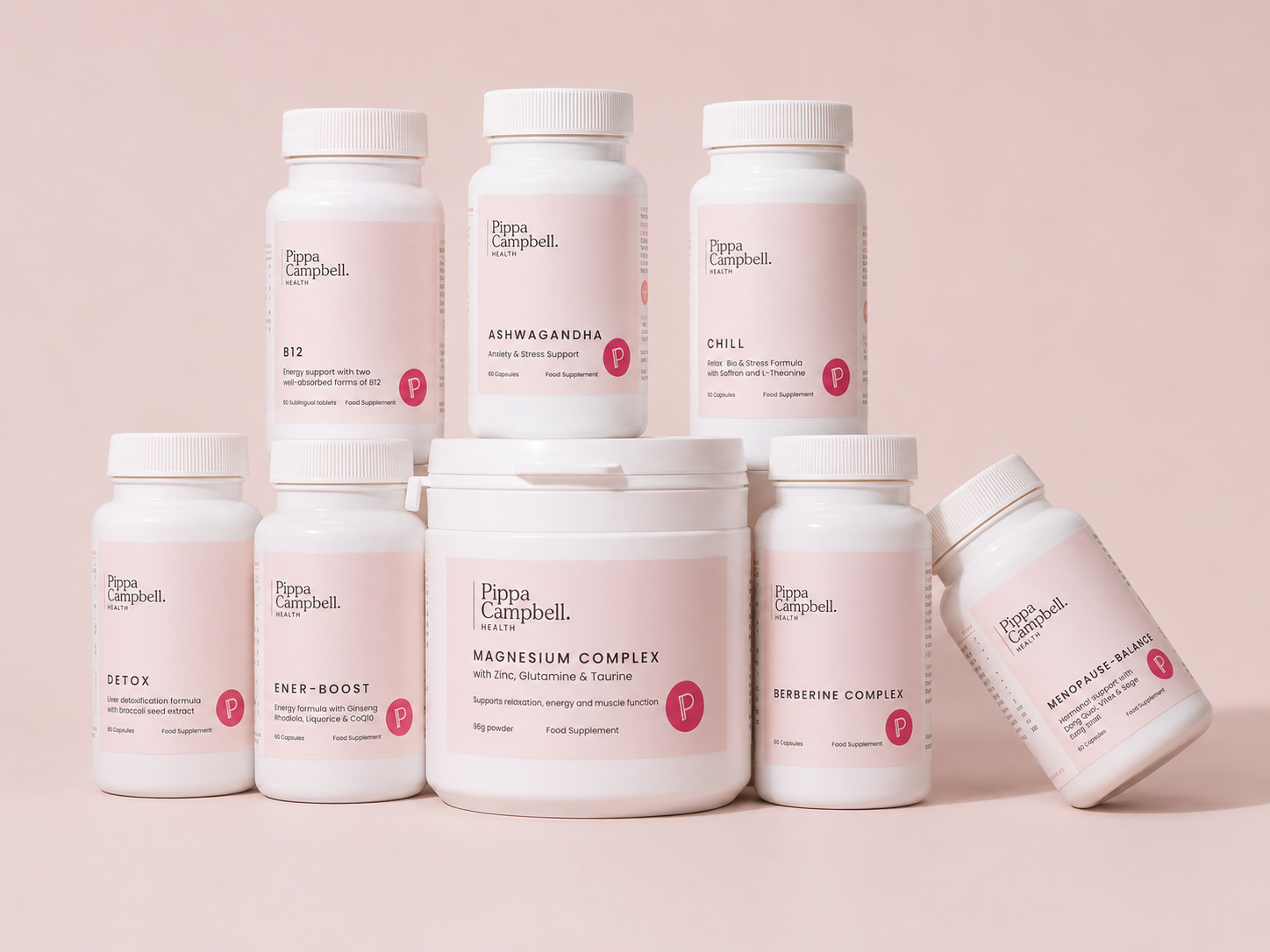
My first recommendation for the wired-but-tired cortisol pattern, persistent low-grade anxiety, and the kind of skin that feels reactive and inflamed is Chill. It contains L-theanine, which can lower cortisol when it spikes rather than simply reducing the feeling of anxiety, alongside Safr’Inside, a patented saffron extract studied in clinical trials for cortisol and emotional balance. Magnesium citrate and B6 in active P5P form complete the formula. Safe to take alongside SSRIs and antidepressants.
Chill addresses the acute spike. Ashwagandha addresses the underlying pattern. The KSM-66 extract is the most researched form of ashwagandha available and supports the body’s long-term stress response and adrenal resilience.³ I use the framing: Chill handles the spike, Ashwagandha fixes the pattern.
Magnesium Complex is one I recommend widely for the stress and skin picture. Magnesium is one of the most commonly depleted minerals in women over forty, and stress depletes it further. The three-form blend, bisglycinate, citrate, and malate, provides different absorption profiles. L-Taurine supports calm and cardiovascular function. L-Glutamine supports gut lining integrity, which is often compromised by prolonged stress. This is considerably more than a standard magnesium supplement.
Curcumin is worth adding where the skin picture is particularly inflammatory. Curcumin is the active compound in turmeric and is well documented for its role in supporting the body’s inflammatory response.⁴ Low cortisol in particular is associated with increased inflammation, and if you are experiencing skin that is reactive, red, or slow to recover, this is the formula I would add alongside the cortisol support stack.
For anyone under sustained pressure, B Complex provides the foundational nutrient layer. Stress burns through B vitamins rapidly, and deficiency in this group affects energy, concentration, mood, and skin health. The formula includes all eight B vitamins in active, bioavailable forms including methylated folate as Quatrefolic and methylcobalamin, forms the body uses directly.
When to test
If you recognise the pattern described in this article, the most reliable next step is to understand what your cortisol is actually doing across the day. Supplements support the system. Testing tells you exactly what you are working with.
The DUTCH test is the most comprehensive way to assess cortisol rhythm. It measures free and metabolised cortisol and cortisone across four points in the day and overnight, giving a full picture of the HPA axis. It can reveal whether cortisol is persistently elevated, whether it crashes at the wrong points, or whether the pattern is more complex. When we test, we stop guessing.
References
¹ Kleyn CE, Schneider L, Saraceno R, et al. Neuroimmunology of stress: skin takes center stage. Journal of Investigative Dermatology. 2006;126(8):1697-1704. PMID: 16845409
² Zaccaro A, Piarulli A, Laurino M, et al. How breath-control can change your life: a systematic review on psycho-physiological correlates of slow breathing. Frontiers in Human Neuroscience. 2018;12:353. PMID: 30245619
³ Chandrasekhar K, Kapoor J, Anishetty S. A prospective, randomized double-blind, placebo-controlled study of safety and efficacy of a high-concentration full-spectrum extract of ashwagandha root in reducing stress and anxiety in adults. Indian Journal of Psychological Medicine. 2012;34(3):255-262. PMID: 23439798
⁴ Panahi Y, Hosseini MS, Khalili N, et al. Effects of curcumin-containing supplements on biomarkers of inflammation and oxidative stress: a systematic review and meta-analysis of randomised controlled trials. Phytomedicine. 2019;64:153023. PMID: 30402990