You feel less strong than you did two years ago. Your back aches in ways it never used to. You may have been told this is just ageing, or that your oestrogen is dropping. But if you are in your early to mid-40s and your periods are still regular, there is something happening that most women are never told about.
Bone loss in midlife is widely attributed to falling oestrogen, but what I see in clinic tells a different story. In women who come to me in their early to mid-40s, bone density can already be declining, and oestrogen levels are still well within range. Cycles look normal on the surface. Nothing has flagged on a standard blood test. Yet something has already begun to change.
The reason is not the hormone most people expect.
Progesterone falls first
Oestrogen tends to get most of the attention when it comes to bone health, but progesterone changes earlier, and its role in bone formation is often missed entirely.
From the mid-30s, ovulation can begin to become less consistent. You may still have regular periods, but the quality of those cycles can change. When ovulation does not occur reliably, progesterone production in the second half of the cycle drops. This can happen quietly, with no obvious symptoms at first.
The significance of this was brought into focus by the work of Dr Jerilynn Prior, who studied female marathon runners who were developing osteoporosis despite having normal, and in some cases elevated, oestrogen levels. What they shared was consistently low progesterone. They were not ovulating regularly, so they were not producing the progesterone needed to support bone formation.
Progesterone stimulates osteoblasts, the cells responsible for building new bone. When progesterone is low, bone formation slows, even when oestrogen is adequate. This is why bone density can begin to decline years before menopause.
At Pippa Campbell Health, this is something we can assess clearly using the DUTCH Test, which measures progesterone metabolites to show how much progesterone is actually being produced and used, not just what is circulating at a single point in time.
Where oestrogen fits in
Oestrogen does play a role in bone health, but it works differently. Its primary function is to slow bone breakdown by regulating osteoclasts, the cells that remove old bone. At menopause, when oestrogen declines more sharply, bone turnover can accelerate temporarily. This is a real effect, but it is not the whole picture, and it does not explain earlier bone loss.
Oestrogen regulates bone breakdown. It does not build new bone. That requires a wider set of conditions to be in place, including progesterone, specific nutrients, and the mechanical stimulus that comes from resistance training. Looking at oestrogen alone misses most of what is actually driving the problem.
Calcium absorption matters more than calcium intake
Most women eating a varied diet are not short on calcium. What is far more common is poor absorption.
Stomach acid is essential for releasing minerals from food so they can be taken up properly. With age, and particularly under conditions of chronic stress, stomach acid can decline. Certain medications also reduce it. This means calcium-rich foods can pass through without being absorbed effectively.
Vitamin D is another critical factor. Without adequate vitamin D, calcium cannot be properly absorbed or directed into bone. Deficiency is extremely common in the UK, and it is one of the first things we assess at Pippa Campbell Health. Where levels are low, supplementation needs to go beyond vitamin D alone. We use PCH D3 Vegan Complex, which provides D3 alongside vitamin K2 and vitamin A. K2 is particularly important because it directs calcium into bone rather than into soft tissue, where it does not belong.
Why magnesium is central to bone health
Magnesium is involved in activating vitamin D, regulating how calcium moves through the body, and supporting the enzymes that build bone structure. Without it, much of what is taken in nutritionally cannot be used effectively. Depletion is common in women dealing with ongoing stress, disrupted sleep, high caffeine intake or diets that have been restricted over time.
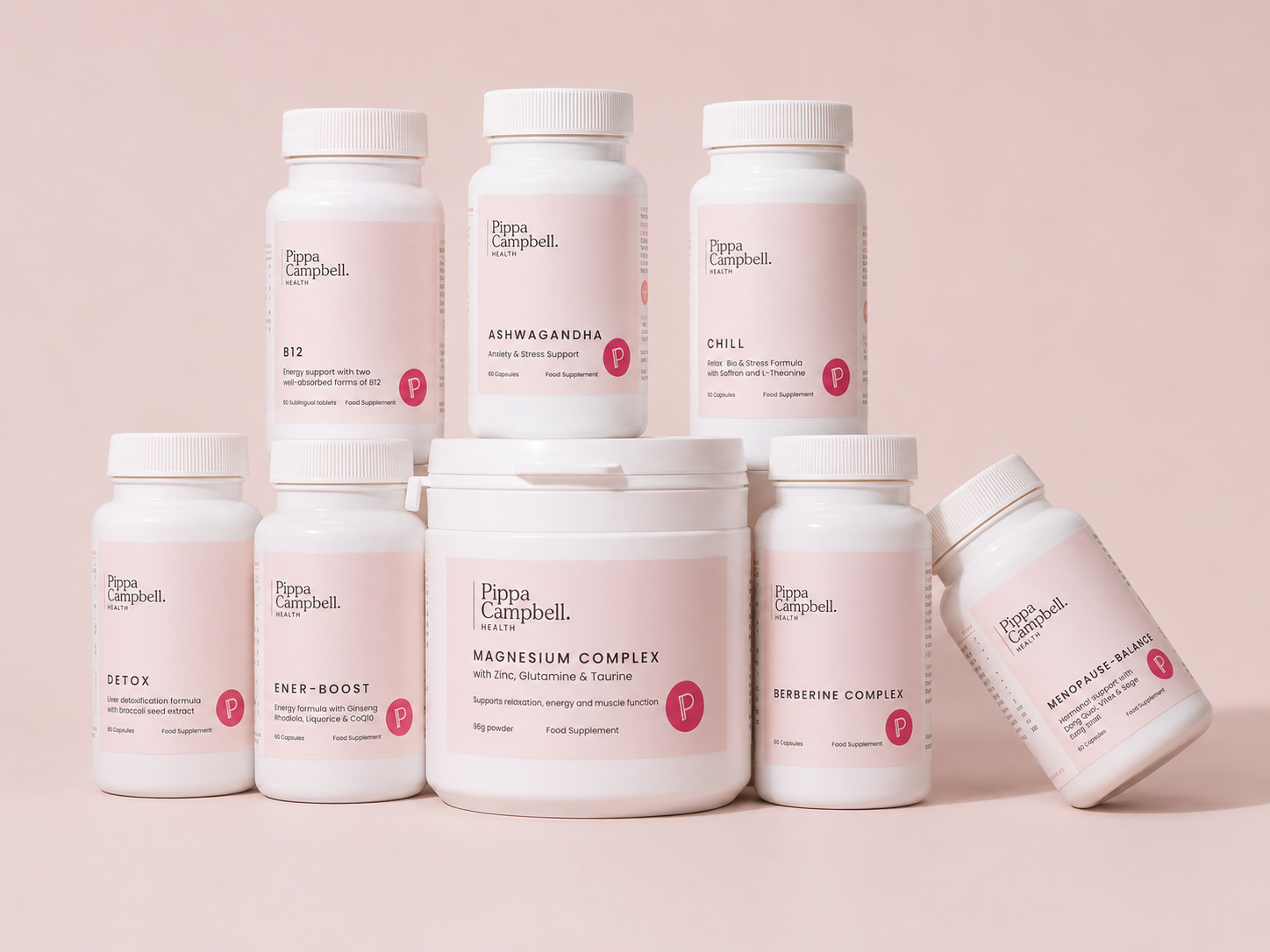
In clinic, we use PCH Magnesium Complex because it contains three forms of magnesium, bisglycinate, citrate and malate, each chosen for absorbability and efficacy. It also includes taurine, which preserves magnesium in the body so more of it is available to support bone metabolism, and zinc, which plays a direct role in bone formation, mineralisation and collagen synthesis.
The role of testosterone and DHEA in bone health
Testosterone and DHEA are not hormones most women associate with bone health, but they play a meaningful role in maintaining bone and muscle mass, particularly as women move through their 40s.
Low DHEA is something we see frequently at Pippa Campbell Health, especially in women carrying a high stress load. It can reduce bone strength and muscle resilience over time.
One of the most effective ways to support androgen levels naturally is resistance training. Strength training stimulates bone-building cells, improves insulin sensitivity, and supports the hormonal environment needed to maintain bone density. This is not optional in midlife. It is one of the most important things a woman can do, and it is something I prioritise with every client.
What actually drives bone loss in midlife
Bone health is the result of multiple systems working together. When one part of that system is under-supported, the effects accumulate over time.
What makes the biggest difference is addressing the foundations consistently: progesterone production through regular ovulation, magnesium to regulate calcium and support bone enzyme activity, vitamin D3 with K2 to ensure minerals are absorbed and directed correctly, good digestive function so that nutrients from food are actually released and taken up, a diet built around whole foods and broad-leaf greens, and strength training as a non-negotiable stimulus for bone.
A single nutrient or a single hormone will not resolve this. What matters is understanding which part of the system is under pressure for you, specifically.
Where to start
The Metabolic Type Quiz at Pippa Campbell Health is a useful first step. It looks at your symptoms and identifies the underlying hormonal and metabolic patterns most likely to be affecting you, so you can begin to see where your body needs the most attention.
If you need expert advice, a 15-minute Discovery Consultation with one of our practitioners trained in the Pippa Campbell Method is a good place to start. In this focused session, your practitioner will review your primary symptoms and health goals, identify the key hormonal or metabolic patterns at play, and outline the most suitable path forward for you.
References: